Casey Hartman’s post-exorcism trauma
Exorcist FallsCasey Hartman’s post-exorcism trauma is presented as an uncertain and lasting aftermath, not a clean recovery: after Malephar is driven from him, Casey appears dazed, wary of Jason Crowder, and increasingly entangled in the family’s fear and suspicion. The narrative gives no clinical diagnosis or simple account of what Casey remembers. Instead, his mother’s concern, his guarded behavior, and the later revelation of his own violence leave open the question of what an exorcism can repair.
Immediate Aftermath
Two nights after the ordeal, Crowder asks Liz Hartman how Casey is doing. She describes him as shell-shocked, like a soldier with post-traumatic stress disorder, and says he spends much of his time walking around in a daze. The comparison communicates the severity of his apparent distress, but it is Liz’s description, not a formal diagnosis.
Crowder suggests that Casey may simply be fatigued after what his body endured. Liz does not seem to hear the reassurance: her greater fear concerns his mind and soul. Her response draws a distinction between physical exhaustion and a less visible injury that she cannot assess or soothe. Casey has survived the possession, but survival has not made him seem settled or well.
Crowder’s uncertainty is sharpened by the lack of dependable knowledge about life after exorcism. He reflects that church records say little about what happens to hosts afterward; occasional claims that they return to normal lives offer scant verifiable detail. He wonders what normality could mean after a malevolent spirit has abused someone’s body, and what such a person might dream or remember. His interest has become personal because Malephar, once inside Casey, now dwells within Crowder. That parallel makes him attentive to Casey’s condition, while giving him no reliable means of interpreting it.
Wariness and Family Strain
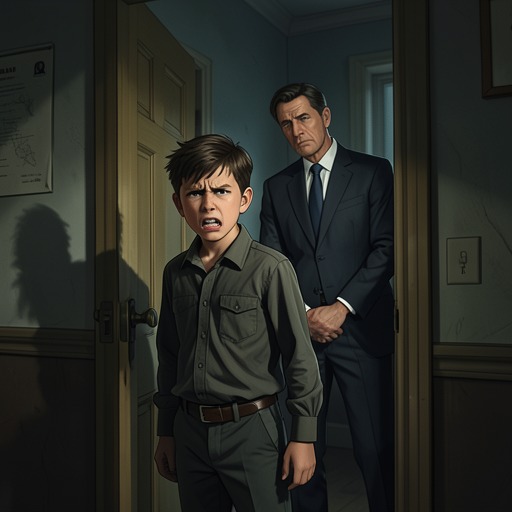
When Casey appears in the shadowed hallway, his one-shouldered shrug seems far more world-weary than a fourteen-year-old’s should. He asks whether his mother and Crowder want him there, as though his presence might be unwelcome. Liz answers that she wants him with her and that Crowder does too. Crowder means it: seeing Casey eases fears he has carried since their ordeal, though the boy seems more cynical than he had hoped.
That relief is soon qualified. Casey asks why Crowder came over when no one invited him. Crowder reads mistrust, and perhaps dislike, in Casey’s eyes; he cannot tell what Casey remembers or suspects. He knows that both of them have housed Malephar and been exposed to the demon’s thoughts and desires. The shared experience links them, but it does not create trust. Crowder’s fear that Malephar might seize control of him again also makes him wonder whether Casey can sense the demon’s presence in his former rescuer.
The unease reaches beyond the two of them. Carolyn Hartman tells Crowder that Casey has described him as a fake priest and claimed that he wants to touch Liz. The report inflames Crowder, who resents being judged by Casey and the rest of the family and fixates on his desire to pursue Liz. The scene therefore presents Casey’s post-exorcism condition within a strained household: his suspicion matters, but Crowder’s own possessiveness and anger also shape the conflict. The narrative does not establish that Casey’s claims are symptoms of trauma, or that the exorcism alone accounts for the family’s distrust.
Memory, Guilt, and Uncertainty
The story offers no clear account of what Casey remembers from his possession. Crowder repeatedly wonders whether the boy recalls the ordeal, but uncertainty persists even as Crowder’s own experiences become more disturbing. At one point, Crowder sees a vivid memory-like image of himself attacking Julia Deveroux and cannot determine whether he committed the murder or whether Malephar manipulated his perception. Those images belong to Crowder, not Casey; their importance here is that the narration separates Casey’s unspoken memories from the demon-related uncertainty experienced by his former host.
Casey’s later admission that he committed murder further complicates any expectation that exorcism has resolved the danger. Crowder tells Father Patterson what Casey has revealed. In the immediate aftermath, Crowder grieves that he has again mistaken an innocent person for a murderer, while also recognizing that Danny Hartman, not Crowder, killed Tyler Raines. The admission establishes a grave later consequence, but the account does not identify Casey’s trauma as its cause. His distress and his responsibility for violence remain facts the narrative holds together without reducing one to the other.
Significance and Limits
Casey’s condition challenges the comforting idea that removing a demon returns its former host to ordinary life. Liz sees a son whose outward daze cannot answer her deeper fear for his mind and soul; Crowder sees a fellow former host but cannot know what Casey remembers. Their concerns are intensified by the church’s sparse record of post-exorcism experience and by Crowder’s own compromised perspective.
The result is an aftermath marked by uncertainty rather than recovery. Casey’s guardedness, his family’s mistrust, and his later admission of murder show that the consequences of possession persist beyond the rite itself. The story does not explain those consequences as a diagnosis or claim that trauma excuses his actions. Instead, it leaves Casey’s inner experience partly inaccessible, making that silence part of the state’s significance.